
Case Study

How EXL’s Full-Funnel Marketing Approach Increased Return on Ad Spend for Lake Tahoe Shakespeare Festival
The Lake Tahoe Shakespeare Festival competes for attention in a crowded summer entertainment market across the Lake Tahoe and Reno region. In recent years, that competition has intensified as tourism has rebounded, operating costs have risen, and new events and attractions have entered the landscape. At the same time, economic trends have made early ticket sales less predictable, even for well-established annual events.
To navigate these conditions, the Lake Tahoe Shakespeare Festival continued its 20-year partnership with EXL Media to plan and manage a multi-channel paid media strategy designed to increase ticket sales, improve return on ad spend, and drive qualified traffic to the festival’s website.
The Challenge
Converting interest amid changing consumer behavior
For the 2025 season, the Lake Tahoe Shakespeare Festival had clear goals around online ticket sales and revenue growth. However, year-over-year preseason ticket sales were down 20 percent, driven largely by declining performance from the email database.
New privacy features and email filtering inflated opens without driving website sessions or conversions. As a result, early-season demand sales lagged significantly, making it clear that awareness alone would not close the gap.
EXL Media needed to adapt to evolving consumer travel and planning behavior and align media platforms, timing, and targeting with when audiences were actually making decisions about summer experiences.
The Strategy
Implement new media channels. Optimize continuously.
EXL Media built a performance-driven paid media strategy centered on channels where online ticket sales could be measured and optimized in real time. Every platform and placement was selected with a focus on targeting precision, timing, and conversion tracking.
Based on prior-year performance and slower early-season ticket sales patterns, Google paid search was launched several weeks earlier than in previous seasons to capture early intent and offset declines from email-driven traffic. Non-branded search played a critical role in intercepting audiences actively researching things to do, events, and performances in the region.
To reach incremental audiences in drive markets more efficiently, EXL reallocated a portion of spend from traditional print and radio into connected television. This introduced a stronger visual storytelling layer while preserving the ability to measure downstream ticket sales.Across all digital platforms, campaigns were continuously monitored and optimized against key performance indicators, with an emphasis on engagement quality and revenue contribution. A supporting awareness layer through selective outdoor placements, rack cards, and signage maintained visibility without diluting performance-focused investment
Audience Targeting, Timing, and Reach
Audience Targeting:
- Primary DMA: Sacramento & San Francisco Drive Market
- Primary DMA: Reno
- Secondary DMA: Fly traffic into Reno Tahoe International Airport
Timing:
June – July: focus on Sacramento & San Francisco Drive Markets
July – August: increase focus on Reno market
| Budget: | $93,225 |
| Negotiated Media Value: | $145,964 |
The Tactics
Using a strategy grounded in targeting, timing, and tracking, EXL launched a fully integrated paid media campaign.
- Google Search: Google paid search expanded non-branded keyword coverage and launched earlier in the season to compensate for declines in early ticket sales from email. Branded terms were supported through the Google Grant program.
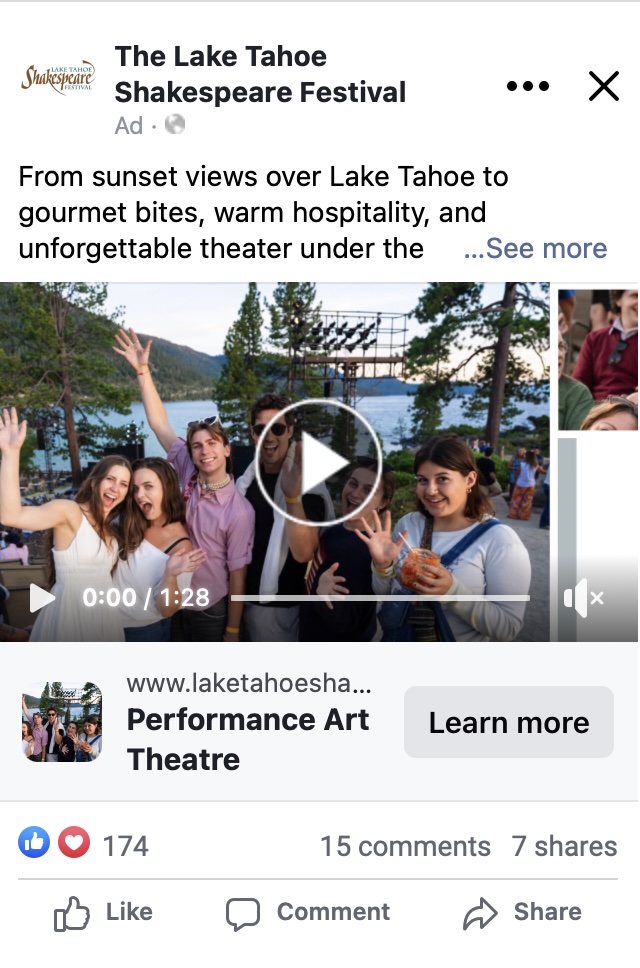
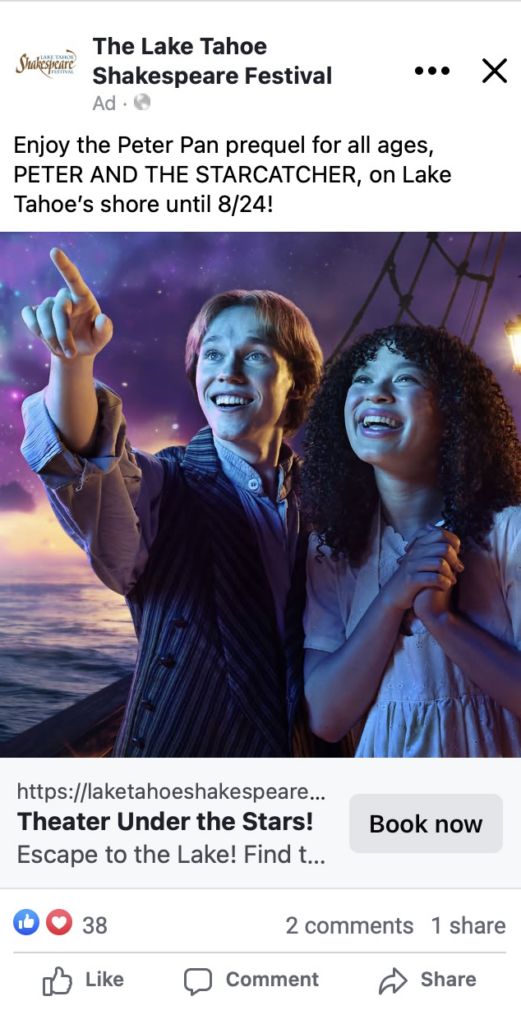
- Social Media: Meta advertising ran across Facebook and Instagram using a mix of formats and placements. Campaigns targeted visitors across all primary markets, CRM-based lookalike audiences, website retargeting segments, and previously engaged users through boosted posts. Budget was actively shifted between platforms and markets based on real-time ROAS performance.
- Connected Television: Connected television was added to reach drive-market audiences in the San Francisco DMA, delivering high-impact video creative with direct pathways to ticket purchase. Ticket sales attributed through Google Analytics validated the role of connected television as an effective upper-funnel channel within a destination-driven market.
- Late Season Push: Late in the season, an additional $5,000 in media budget was introduced to support final ticket sales. EXL allocated spend toward top-performing markets and platforms, front-loading destination markets earlier in the purchase cycle and shifting focus to local audiences for last-chance attendance. As performance softened toward season end, a portion of this budget was intentionally held back and reserved for early-season activation in the following year.

The Results
EXL’s continuously optimized paid media management drove all primary KPIs, including impressions, clicks, and website performance. Most importantly, efficient and targeted media allocation increased return on ad spend, driving higher ticket sales and revenue.
Revenue Goals
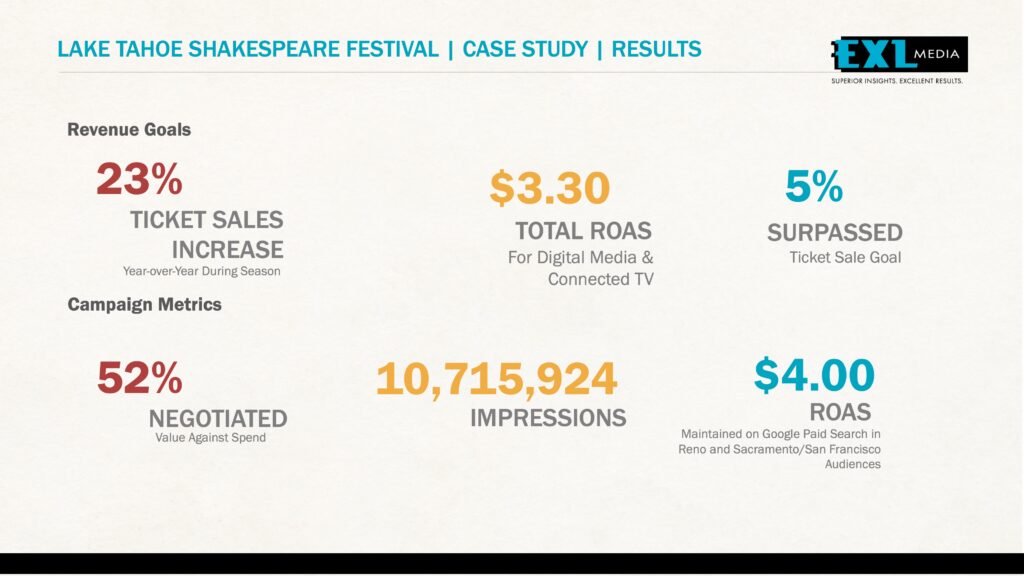
EXL offset the 20 percent decline in early ticket sales with a 23 percent year-over-year increase in ticket sales during the regular season, resulting in an overall 7 percent increase in ticket sales for the year.
- Surpassed ticket sale goal by 5%
- Surpassed revenue goal by 3.8%
- Total ROAS for digital media buy and connected TV was $3.30 (up from $2.40 prior season)
Channel Performance
- Paid Search Optimization: Early in the season, paid search in Sacramento and San Francisco delivered high ROAS, prompting a shift in budget allocation. As consumer behavior changed later in the season, spend was reallocated to Reno to maintain efficiency.
- Meta: Meta lookalike audience campaigns delivered the highest revenue and engagement.
- Connected Television: Connected television emerged as the third-highest revenue-driving channel after paid search and Meta advertising.
- Paid Search: Branded terms were supported through the Google Grant program, which EXL Media has managed since inception, generating approximately $40,000 in revenue from pro bono media value.
Looking Ahead
Insights from the 2025 season are already informing future strategy. Early-season ticket sales for 2026 are up 16.7 percent year to date, supported by Google Grant and Meta boosted post activation using the saved dollars from the 2025 campaign.